
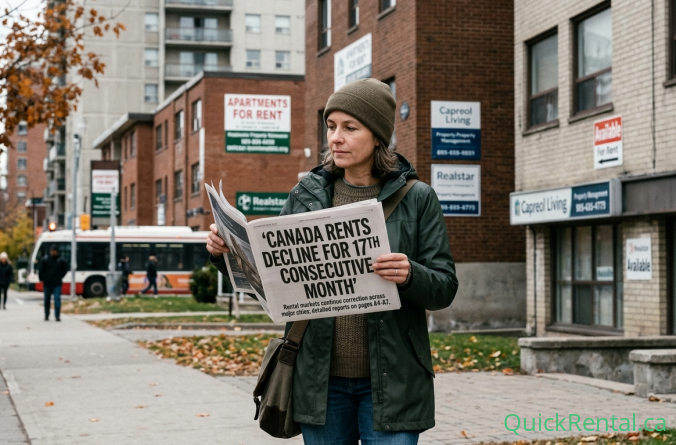
What It Means for Toronto Renters in 2026
Published April 3, 2026 | QuickRental.ca Rental Market Insights
Canadian renters are finally catching a long-awaited break. According to the latest data from Rentals.ca and Urbanation, average asking rents for rentals across Canada fell to $2,030 in February 2026 — the 17th consecutive month of year-over-year declines, and the lowest national average in 33 months. For Toronto renters in particular, this is one of the most meaningful market shifts in recent memory.
In this report, QuickRental.ca breaks down what’s driving the decline, how different property types and neighbourhoods are affected, and what renters in Toronto and the GTA can do right now to take advantage of better affordability.
Key Numbers at a Glance
| National average asking rent (February 2026) | $2,030 |
| Year-over-year change (national) | -2.8% |
| Month-over-month change (national) | -1.3% |
| Consecutive months of YoY rent decline | 17 |
| Toronto average asking rent (all property types) | $2,482 |
| Toronto YoY change | -7.9% |
| Toronto one-bedroom average | $2,201 |
| Vancouver average (most expensive city) | $2,672 |
| Ontario provincial YoY change | -4.3% |
| Rent-to-income ratio (national) | 29.5% (6-yr low) |
| Key Insight: For the first time in six years, the average Canadian renter is spending less than 30% of their income on rent — a major affordability milestone. |
What’s Driving the Decline?
The 17-month streak of falling Toronto rentals is the result of two forces colliding: a significant wave of new rental supply entering the market at exactly the same time that demand has softened due to reduced immigration levels and broader economic uncertainty.
Urbanation president Shaun Hildebrand described the current environment as "Canada’s largest downturn in rents in recent history" — a supply-demand imbalance that is creating rare negotiating power for renters.
Supply Side
- Record numbers of purpose-built rental completions in 2024 and 2025 are flooding the market with new units.
- Condominium investors who bought pre-construction units are now listing them as rentals listings simultaneously, adding to inventory.
- Vacancy rates have climbed above the 10-year average in many major markets, including reaching their highest level in over 30 years in Vancouver.
Demand Side
- Federal immigration reductions in late 2024 and 2025 removed a major source of rental demand.
- Economic uncertainty and rising unemployment (Canada lost 84,000 jobs in February 2026) are prompting renters to stay put or double up.
- Potential buyers continue to wait on the sidelines, but many are already in existing rental listings, dampening new rental demand.
Toronto Rental Market: What the Numbers Say
Toronto has seen some of the steepest declines in the country for apartments for rent Toronto. Rents fell 7.9% year-over-year across all property types in February — nearly three times the national rate of decline. Here is how individual unit types are performing:
| Toronto all-property average | $2,482 (-7.9% YoY) |
| Toronto one-bedroom | $2,201 (-6.9% YoY) |
| Toronto two-bedroom (est.) | ~$2,900 (-5% to -7% YoY) |
| Ontario average asking rent | $2,229 (-4.3% YoY) |
Toronto condo apartment rents have led the decline, falling 5.1% year-over-year to $2,082. Purpose-built rental apartments have held up better, down only 1.9% to $2,030 — reflecting the higher quality and amenity levels that attract stable, long-term tenants.
For renters who have been priced out of Toronto neighbourhoods like Liberty Village, the Annex, or Leslieville over the past three years, this correction is opening real opportunities. A one-bedroom that was $2,500 in 2023 is now commonly listed in the $2,100–$2,200 range.
| QuickRental.ca Tip: If you are searching for apartments in Toronto right now, this is the strongest renter’s market since pre-pandemic 2020. Use the current vacancy surplus to negotiate free first month, parking inclusion, or below-asking rent. |
Provincial Breakdown: Who’s Falling, Who’s Rising?
The national decline masks some important regional variation. Most of Canada’s major provinces are posting significant rent reductions, but a few smaller markets are bucking the trend.
| Alberta (steepest drop) | -4.4% → avg. $1,656 |
| Ontario | -4.3% → avg. $2,229 |
| British Columbia | -4.2% → avg. $2,354 |
| Quebec | -2.7% → avg. $1,916 |
| Nova Scotia | +6.3% → avg. $2,307 |
| Saskatchewan | +3.3% → avg. $1,373 |
| Manitoba | +2.3% → avg. $1,644 |
Nova Scotia’s rising rents stand out nationally — Halifax in particular has been growing faster than any other major market, driven by interprovincial migration and limited supply. For GTA renters, Ontario remains the most relevant story, and the 4.3% provincial decline translates into meaningful savings at scale.
The Fine Print: You’re Getting Less Space
There is one important caveat to the improving affordability picture. While headline rents are falling, the average size of rental units has also been shrinking. According to Rentals.ca data for rental listings , the average listing size dropped from 754 sq ft in 2024 to 719 sq ft in early 2026 — a decline of roughly 4.6%.
When measured on a per-square-foot basis, asking rents have actually continued to edge upward. This is largely driven by a growing share of smaller units in the market mix — developers are building more bachelor and one-bedroom units because development charges for smaller units in cities like Toronto are significantly lower than for two- and three-bedroom apartments.
For renters prioritizing space — families, remote workers, or anyone who needs a home office — this trend means shopping carefully and comparing actual unit sizes, not just monthly rent figures.
| Renter Advice: Always check the square footage before booking a viewing. A $2,100 one-bedroom at 550 sq ft represents a very different value than a $2,200 one-bedroom at 750 sq ft. |
What Toronto Renters Should Do Right Now
This is one of the best renter’s markets in years. Here is how to make the most of it:
1. Negotiate Aggressively
- Vacancy rates are elevated. Landlords are competing for tenants in a way they were not in 2022 or 2023.
- Ask for a free first month, lower than asking price, or the inclusion of parking and utilities.
- If a unit has been listed for more than 30 days, it is almost certain the landlord has room to negotiate.
- Renters currently in older or smaller units can often move up — bigger apartment, better building, better neighbourhood — for the same or similar monthly cost as they were paying two years ago.
- With Toronto one-bedrooms at $2,201 and two-bedrooms falling proportionally, the gap between unit sizes is narrower than it has been since 2021.
- Mississauga rents are tracking lower than Toronto’s core neighbourhoods and offer better value-per-square-foot.
- Brampton and surrounding suburbs offer even further savings, with strong transit connections into Toronto.
- Rental markets historically pick up in May and June as lease expirations cluster. Securing a unit in April typically means fewer competitors and more landlord flexibility.
- If you find the right unit at a good price, do not wait — vacancy rates will not stay this high indefinitely.
| Browse Listings: QuickRental.ca has verified Toronto, Mississauga, and Brampton listings updated daily. Use our map search to find exactly what fits your budget and neighbourhood preferences. |
Will Rents Keep Falling in 2026?
Most market analysts expect rents to stabilize — rather than fall sharply further — through the second half of 2026. Here is why:
- The pace of annual decline has been slowing. January’s year-over-year drop was only 2.0%, slightly less than December’s. February’s 2.8% was larger month-over-month, but the trend line is flattening.
- Some major cities — Vancouver, Ottawa, Calgary, Edmonton, and Montreal — saw rents rise month-over-month in February even as annual comparisons remained negative.
- Immigration policy could reverse course, which would rapidly re-energize rental demand.
- Construction financing is getting harder to secure, meaning the pipeline of new supply will slow in 2027 and 2028 — which typically leads to renewed rental pressure.
Context: Where Rents Stand Relative to Pre-Pandemic
Despite 17 months of declines, it is important to keep perspective. National asking rents remain approximately 14% higher than they were in early 2020, before the pandemic-era surge. Toronto rents have corrected sharply but are still substantially above their 2019 baselines.
This means the current correction is best understood as a partial unwinding of pandemic-era excess rather than a return to pre-2020 affordability. For renters who need housing in 2026, the market is far more accessible than it was in 2022 or 2023 — but renters should not expect rents to fall to 2019 levels.
Find Your Next Rental on QuickRental.ca
QuickRental.ca is the Toronto-focused rental platform built for renters who want verified listings, local expertise, and a faster path to their next home. Whether you are searching for a one-bedroom condo in downtown Toronto, a spacious apartment in Mississauga, or an affordable room in Brampton, QuickRental.ca has you covered.
Browse apartments and condos across Toronto and the GTA: Search Available Rentals
Looking for Mississauga options? Read our guide: Apartments for Rent in Mississauga
Exploring Brampton? Check our neighbourhood guide: Rooms for Rent in Brampton
Want to understand the full cost of renting? Read: The Hidden Costs of Renting in Canada
QuickRental.ca is a modern rental marketplace designed to connect renters and landlords faster and more efficiently across Canada. With a streamlined search experience and up‑to‑date listings, renters can quickly find homes that match their lifestyle, budget, and location—without the hassle. For landlords and property managers, QuickRental.ca offers powerful listing and marketing tools that boost visibility, attract quality tenants, and reduce vacancy time. Built for speed, simplicity, and results, QuickRental.ca makes renting smarter, easier, and more accessible for everyone.
https://www.youtube.com/@QuickHomeRental
https://www.facebook.com/QuickRentalToronto
https://ca.pinterest.com/quickrentaltoronto
https://flipboard.com/@QuickRental2025
https://www.linkedin.com/in/quick-rental/
https://www.reddit.com/r/QUICKRENTAL
#bramptonrentals #mississaugabasement #torontobasement
#ontariorentals #gtarentals #caledonrentals #scarboroughrentals
#etobicokerentals #canadarentals #ontariohousing